
ICF Construction Ireland
Updated: Aug 24
Case Study: Cost, Time & Energy Performance Compared With Traditional Building Method
Case Study Overview
This case study compares ICF construction in Ireland against three common construction methods:
Traditional cavity blockwork
Timber frame construction
Standard reinforced concrete / block construction
Insulated Concrete Formwork, known as ICF
The aim is to compare ICF on the areas that matter most to homeowners, developers and architects:
Build cost
Construction speed
Airtightness
Thermal performance
Heating demand
Long-term energy savings
Structural durability
Suitability for Irish residential construction
ICF construction is not always the cheapest option upfront. However, when build speed, insulation, airtightness and long-term energy performance are considered together, it can become one of the strongest choices for modern homes in Ireland.

Case Study Property
For comparison, we will use a realistic Irish residential project:
Item | Assumption |
Property type | Detached one-off house |
Floor area | 200m² |
Wall area | Approx. 220m² external wall area |
Location | Ireland |
Heating system | Air-to-water heat pump |
Target rating | A-rated / low-energy home |
Construction scope | External walls, foundations, structure and envelope performance |
This is a modelled comparison using published performance data and Irish construction context. Final project costs vary depending on site access, ground conditions, engineer requirements, finish level, location and contractor pricing.
What Is ICF Construction?
ICF stands for Insulated Concrete Formwork. It uses hollow insulated blocks or panels that are stacked on site, reinforced with steel and filled with concrete.
The finished wall includes:
External insulation
Internal insulation
Reinforced concrete core
Continuous thermal envelope
High airtightness potential
Strong structural performance
Unlike traditional blockwork, the insulation is built into the wall system from the beginning. Unlike timber frame, the main structure is reinforced concrete.
Cost Comparison: ICF vs Traditional Construction Learn More>
The biggest question most homeowners ask is simple:
Is ICF more expensive than blockwork?
Generally, yes — but not always by as much as people expect.
Irish ICF supplier guidance suggests the supply and build cost of an ICF wall system is typically around 5–15% more than a standard cavity block wall built to current regulations.
Estimated Wall System Cost Comparison
Construction Type | Typical Cost Position | Notes |
Standard cavity blockwork | Baseline | Familiar method, widely available labour |
Timber frame | Similar or slightly lower/faster | Depends on supplier and specification |
Approx. 5–15% higher for wall system | Higher material cost, but faster structure and better envelope | |
Reinforced concrete / block hybrid | Variable | Depends heavily on engineering and formwork |
Example Cost Model
For a 200m² home, assume the external wall package for traditional blockwork is approximately €45,000–€55,000 depending on specification.
Using the 5–15% ICF premium:
Method | Estimated Wall Package |
Traditional cavity blockwork | €45,000–€55,000 |
€47,250–€63,250 | |
Difference | Approx. €2,250–€8,250 extra |
This does not mean the full house costs 15% more. The premium applies mainly to the walling system, not necessarily the whole build.
On a full residential build, the total project uplift may be much smaller once speed, insulation, airtightness and reduced remedial detailing are considered.
Time Comparison: ICF vs Blockwork
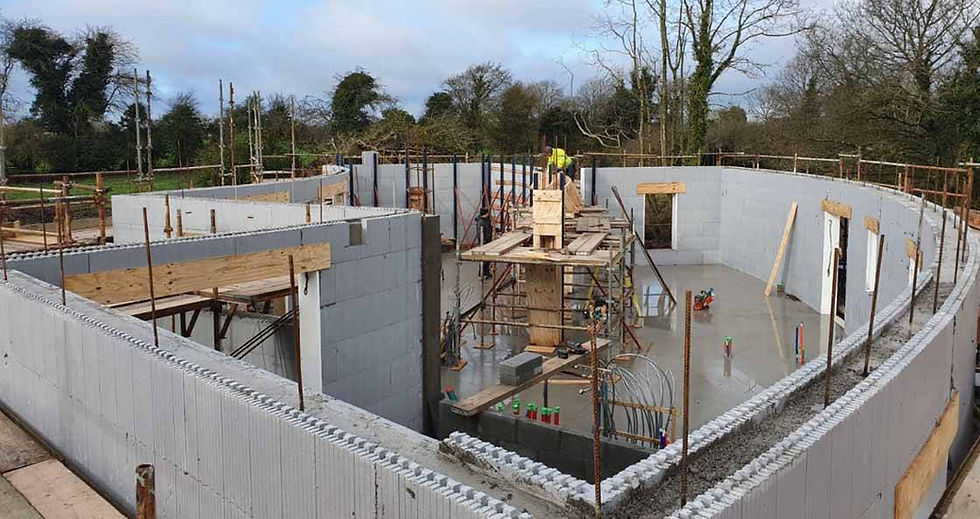
ICF can be faster because the system combines structure, insulation and formwork in one process.
Traditional blockwork often requires:
Inner leaf blockwork
Outer leaf blockwork
Cavity insulation
Wall ties
Additional airtightness detailing
More wet trades
More labour time
ICF construction typically involves:
Stacking ICF forms
Installing reinforcement
Bracing and alignment
Concrete pour
Integrated insulation already in place
A comparative Irish student research project from TUS described ICF as faster than traditional masonry due to assembly and labour requirements.
Programme Comparison
Stage | Blockwork | ICF |
External wall construction | Slower | Faster |
Insulation install | Separate stage | Built into system |
Airtightness detailing | More complex | Easier to achieve with correct detailing |
Concrete / structure | Block-dependent | Monolithic reinforced concrete core |
Weather delay risk | Higher | Lower once system is poured |
Practical Time Saving
For a 200m² house, ICF can often save 1–3 weeks on the structural wall phase compared with traditional blockwork, depending on crew experience, house complexity and pour scheduling.
The biggest time advantage is not just speed of stacking. It is that structure and insulation are being completed together.
Energy Performance Comparison
ICF’s main strength is energy efficiency.
A 2025 peer-reviewed study comparing ICF and wood-framed houses found that ICF houses used up to 41% less electricity and at least 5% less natural gas than wood-framed homes in the sample studied.
Other research comparing ICF and timber-frame construction found total energy requirements for ICF houses were 5–9% lower than comparable wood-frame houses.
Oak Ridge National Laboratory research also reported ICF energy savings in the region of around 11% in its thermal mass study.
Energy Performance Table
Construction Type | Energy Performance |
Standard blockwork | Good if well insulated and airtight |
Timber frame | Good insulation potential, lightweight structure |
ICF | Excellent insulation, thermal mass and airtightness |
Passive-level ICF | Very high performance when paired with MVHR and airtight detailing |
The important point is this:
ICF does not save energy from insulation alone. It performs well because it combines:
Continuous insulation
Reduced thermal bridging
Airtight construction
Reinforced concrete thermal mass
Stable internal temperatures
Airtightness: Why It Matters
Airtightness is one of the biggest differences between average construction and high-performance construction.
Passive House guidance requires airtightness of 0.6 air changes per hour at 50 Pascals, often written as 0.6 ACH50.
Airtightness Comparison
Construction Type | Airtightness Difficulty |
Traditional blockwork | Achievable, but requires careful plaster and junction detailing |
Timber frame | Achievable, but membrane detailing is critical |
ICF | Naturally strong due to monolithic concrete core |
Passive house standard | Requires specialist detailing regardless of method |
ICF is not automatically passive-house airtight, but it gives contractors a strong starting point because the poured concrete core reduces many leakage paths.
Heating Cost Example
SEAI published a real-world example of a 200m² Irish bungalow upgraded from C3 to A3 with a heat pump, where the first full heating season electricity cost for the heat pump was around €1,300, compared with around €1,550 on oil the previous year.
Using that as a practical reference point, a high-performance ICF home with excellent airtightness, insulation and heat pump design could potentially reduce heating demand further than a standard compliant home.
Example Annual Heating Cost Model
Home Type | Estimated Annual Heating Cost |
Older oil-heated home | €1,500–€2,500+ |
New compliant A-rated home | €900–€1,500 |
High-performance ICF home | €600–€1,200 |
Passive-level home | Potentially lower again |
These are not guaranteed figures. Actual costs depend on electricity tariffs, occupant behaviour, house size, airtightness, glazing, ventilation, heat pump efficiency and thermostat settings.
ICF vs Blockwork: Practical Comparison
Category | Traditional Blockwork | ICF Construction |
Upfront wall cost | Usually lower | Usually 5–15% higher |
Build speed | Slower | Faster wall installation |
Labour availability | Very high | Specialist installers needed |
Insulation | Added separately | Built into system |
Airtightness | Good if detailed well | Very strong potential |
Thermal bridging | Needs careful detailing | Reduced through continuous insulation |
Structure | Masonry walls | Reinforced concrete core |
Sound insulation | Good | Very good |
Energy performance | Good | Excellent |
Long-term durability | Good | Excellent |
ICF vs Timber Frame
Timber frame is popular because it is fast and can be very energy efficient. However, ICF has advantages where clients want a heavier, more robust, concrete-based structure.
Category | Timber Frame | ICF |
Build speed | Fast | Fast |
Structure | Lightweight timber | Reinforced concrete |
Thermal mass | Low | High |
Airtightness | Depends on membranes | Strong monolithic core |
Moisture sensitivity | Needs careful protection | Less moisture-sensitive structurally |
Acoustic performance | Good with detailing | Very good |
Fire resistance | Requires system compliance | Concrete core advantage |
Energy performance | Very good | Very good to excellent |
Timber frame can be highly efficient, but ICF gives a different kind of performance: heavier, quieter, more robust and thermally stable.
Lifecycle Value: Where ICF Can Win
The real value of ICF is not just the wall cost.
ICF can deliver value through:
Reduced heating demand
Faster structural programme
Lower thermal bridging risk
Strong airtightness potential
High sound insulation
Long-term structural durability
Better comfort
Potentially stronger resale appeal for energy-efficient homes
If ICF adds €5,000–€10,000 to the wall package but saves €500–€1,000 per year in energy and comfort-related running costs over time, the long-term value becomes easier to justify.
Simple Payback Example
Extra ICF Cost | Annual Energy Saving | Simple Payback |
€5,000 | €500/year | 10 years |
€7,500 | €750/year | 10 years |
€10,000 | €1,000/year | 10 years |
This is simplified and does not include comfort, resale value, carbon, maintenance, build speed or reduced remedial work.
When ICF Makes The Most Sense
ICF is especially suitable for:
One-off homes
Passive house projects
A-rated homes
Exposed rural sites
High-end residential construction
Basement or retaining wall projects
Energy-efficient extensions
Homes using heat pumps and MVHR
Projects where strength and airtightness matter
It may be less suitable where the client is only chasing the lowest upfront wall cost and not considering lifecycle value.
Key Takeaway
ICF construction in Ireland usually costs more upfront than standard cavity blockwork, but the difference is often much smaller than expected when measured across the full project.
The strongest case for ICF is not just cost. It is the combination of:
Faster structural build
Integrated insulation
Reinforced concrete strength
Excellent airtightness potential
Reduced thermal bridging
Lower long-term heating demand
Better comfort
Strong performance for modern energy-efficient homes
For homeowners and developers planning a high-performance build in Ireland, ICF should be considered not as a premium extra, but as a complete structural and energy-performance system.

Comments