
How To Build An A-Rated Home In Ireland
Complete Guide To Design, Insulation, BER, Heating, Ventilation & Green Mortgage Rates
Building an A-rated home in Ireland is not about adding solar panels at the end. It starts with the structure, insulation, airtightness, thermal bridges, heating system and ventilation strategy.
A proper A-rated home should be designed as one complete energy system.
SEAI explains that BER ratings measure a home’s energy performance on a scale from A to G, with A-rated homes being the most energy efficient. The BER certificate also shows the calculated energy value in kWh/m²/year, so the rating is based on modelled energy demand, not just one product or material.
Index
What Makes A Home A-Rated?
Why Fabric Comes First
Wall Construction Options
Insulation Types Explained
Roof Insulation Strategy
Floor & Foundation Insulation
Thermal Bridging
Airtightness
Windows & Doors
Ventilation
Heating System Options
Hot Water Efficiency
Solar PV & Renewables
Orientation & Building Design
Why Higher BER Ratings Lower Mortgage Rates
Irish Green Mortgage Examples
Mortgage Saving Example
BER Bands Explained
Example A-Rated Home Specification
What Can Ruin An A-Rated Home?
Best Route For Alvora Clients

1. How To Build An A-Rated Home In Ireland?
A home reaches an A rating when its calculated energy demand and carbon performance are low enough under the BER assessment method.
The main things that influence the rating are:
Wall insulation
Roof insulation
Floor insulation
Window and door performance
Airtightness
Thermal bridging
Heating system efficiency
Hot water efficiency
Ventilation system
Solar PV or renewable contribution
Orientation and solar gain
Heating controls
Low-energy lighting
Overall construction quality
For new Irish homes, Part L of the Building Regulations sets out conservation of fuel and energy requirements, and the guidance also focuses on thermal bridging and airtightness through Acceptable Construction Details.
2. Why Fabric Comes First
The most important principle is: Reduce heat loss before choosing heating systems.
A poor-quality house with a heat pump is still a poor-quality house. A high-performance house should need very little heat in the first place.
The correct order is:
Design the shape and orientation well
Insulate the walls, roof and floor properly
Remove thermal bridges
Make the house airtight
Install proper ventilation
Choose an efficient heating system
Add renewables such as solar PV
Commission and test everything
This is called a fabric-first approach.
It matters because the BER calculation rewards homes that need less delivered energy. The less heat the home loses, the less energy the heating system must provide.

3. Wall Construction Options For A-Rated Homes
Option 1: ICF Construction
ICF stands for Insulated Concrete Formwork.
It uses insulated blocks or panels filled with reinforced concrete. This creates a wall system with:
Continuous insulation
Reinforced concrete structure
Strong airtightness potential
Thermal mass
Reduced cold bridging
Good acoustic performance
High durability
ICF is especially strong for:
A-rated homes
Passive-style homes
Exposed rural sites
Large detached houses
Heat pump homes
High-end residential projects
Why ICF Helps BER
ICF helps because the wall system combines structure and insulation. It also gives a strong airtightness base because the concrete core reduces air leakage through the wall.
The big benefit is consistency. A traditional wall can perform well on paper, but gaps in insulation, weak junctions and poor airtightness detailing can reduce real-world performance. ICF reduces some of that risk when installed correctly.
Option 2: Timber Frame
Timber frame can also achieve excellent A-rated performance.
Advantages:
Fast construction
High insulation levels
Factory-controlled panels
Lightweight structure
Good for low-energy homes
Watch points:
Airtightness membranes must be perfect
Moisture protection is critical
Acoustic performance may need extra layers
Thermal mass is lower than ICF or masonry
Timber frame can be excellent, but it depends heavily on correct detailing, membrane continuity and site protection.
Option 3: Traditional Blockwork
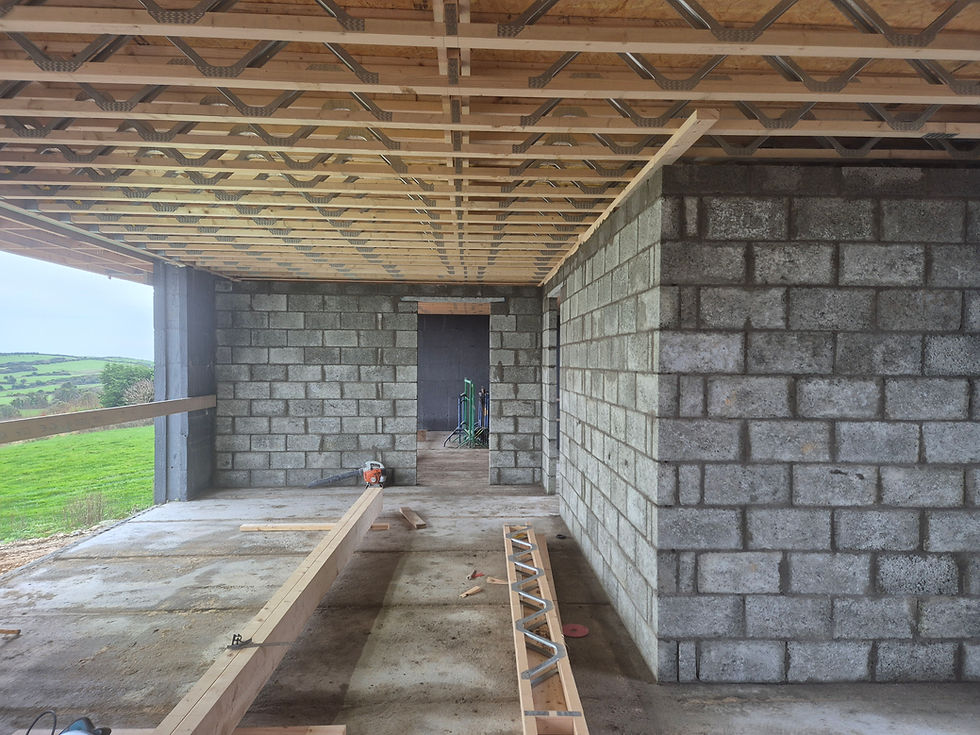
Traditional cavity blockwork can achieve an A rating, but it needs careful detailing.
Advantages:
Familiar to Irish trades
Widely available
Durable
Good thermal mass
Watch points:
Thermal bridging at floor and roof junctions
Cavity insulation quality
Wall ties and openings
Airtightness around services
Window and door reveal detailing
Blockwork is not the problem. Poor detailing is the problem.
A blockwork house can be A-rated, but it needs a very controlled approach to insulation, airtightness and junction design.
Option 4: Structural Insulated Panels
SIPs can offer strong thermal performance and fast installation.
Advantages:
High insulation levels
Fast shell construction
Good factory accuracy
Suitable for low-energy homes
Watch points:
Panel joints must be sealed correctly
Structural design must be coordinated early
Later changes can be difficult
Moisture detailing matters

4. Insulation Types Explained
EPS Insulation
EPS, or expanded polystyrene, is commonly used in ICF systems, external insulation and insulated foundations.
Best for:
ICF walls
External wall insulation
Insulated raft foundations
Floor insulation
Below-ground applications, depending on product type
Advantages:
Good value
Durable
Moisture resistant depending on grade
Works well in continuous insulation systems
Watch points:
Needs correct fire detailing
Must be specified at correct density and grade
Requires proper protection where exposed
XPS Insulation
XPS is often used where higher moisture resistance or compressive strength is needed.
Best for:
Below-ground insulation
Foundation edges
Retaining walls
Inverted roofs
High-load areas
Advantages:
Strong compressive performance
Moisture resistance
Good for ground-contact conditions
Watch points:
Usually more expensive than EPS
Environmental impact depends on product type
PIR Insulation
PIR is a rigid board insulation with strong thermal performance in thinner thicknesses.
Best for:
Roofs
Floors
Cavity walls
Internal insulation
Areas where space is limited
Advantages:
High thermal performance per thickness
Widely available
Common in Irish construction
Watch points:
Gaps between boards reduce performance
Taping and fitting quality are critical
Less forgiving around awkward junctions
Mineral Wool
Mineral wool includes glass wool and rock wool products.
Best for:
Attics
Timber frame walls
Acoustic partitions
Fire-resistant build-ups
Service zones
Advantages:
Good fire performance
Good acoustic performance
Flexible installation
Vapour-open options available
Watch points:
Must not be compressed
Needs wind-tightness in some build-ups
Can slump if poorly installed
Wood Fibre
Wood fibre is often used in breathable or low-carbon construction.
Best for:
Timber frame
Roof build-ups
Retrofit projects
Natural construction systems
Advantages:
Good thermal performance
Good acoustic performance
Breathable
Lower embodied carbon
Helps with summer overheating
Watch points:
Higher cost
Needs correct moisture design
Specialist detailing may be required
Spray Foam
Spray foam is sometimes used for roofs and difficult junctions.
Advantages:
Can improve airtightness
Fills irregular gaps
Useful in certain retrofit situations
Watch points:
Not suitable everywhere
Can trap moisture if wrongly specified
May affect roof ventilation
Can cause issues for future inspections or lenders if poorly documented
For new A-rated homes, spray foam should not be used as a shortcut for proper design.
5. Roof Insulation Strategy
Heat rises, so the roof is a major part of the energy strategy.
Options include:
Cold attic with mineral wool at ceiling level
Warm roof with PIR between and over rafters
Timber roof with wood fibre insulation
Hybrid build-ups
Flat roof insulation systems
Key details:
No gaps at eaves
Airtight attic hatch
Sealed downlights or avoided penetrations
Continuous insulation over wall plate
Careful rooflight detailing
Ventilation strategy matched to roof type
A poorly detailed roof can destroy the performance of an otherwise excellent home.

6. Floor & Foundation Insulation
The floor is often underestimated.
A-rated homes need the insulation below the slab or floor to connect properly with the wall insulation.
Options include:
PIR floor insulation
EPS under-slab insulation
Insulated raft foundation
ICF foundation system
Passive slab system
Key details:
Edge insulation around slab
No cold bridge at wall/floor junction
Correct compressive strength
Radon barrier integration
Service penetrations sealed
Underfloor heating planned early
This is where ICF and insulated foundation systems can perform very well because they help connect wall and floor insulation continuously.
7. Thermal Bridging
A thermal bridge is a weak point where heat escapes faster than surrounding areas.
Common thermal bridges:
Window reveals
Door thresholds
Wall-to-floor junctions
Wall-to-roof junctions
Steel beams
Concrete balconies
Foundation edges
Cavity closers
Service penetrations
Thermal bridging affects:
BER rating
Comfort
Surface condensation risk
Mould risk
Heating demand
Part L guidance specifically highlights thermal bridging and airtightness through Acceptable Construction Details.
The aim is to create a continuous insulated envelope with as few interruptions as possible.
8. Airtightness
Airtightness is one of the biggest differences between an average new build and a true high-performance home.
Air leakage causes:
Heat loss
Draughts
Cold rooms
Poor comfort
Higher energy bills
Reduced BER performance
Important airtightness details:
Window tapes
Door threshold sealing
Airtight membrane or plaster layer
Service cavity
Sealed pipes and cables
Airtight attic hatch
Sealed MVHR duct penetrations
Wall-to-roof junctions
Wall-to-floor junctions
Airtightness should be tested before final finishes so leaks can be fixed.

9. Windows & Doors
Windows are usually weaker thermally than walls, so specification matters.
Important terms:
U-value- Measures heat loss. Lower is better.
G-value- Measures solar gain. Higher means more solar heat enters.
Frame performance- A good glass unit in a poor frame still performs poorly.
Installation- Even expensive triple glazing can underperform if installed badly.
Good A-rated specification:
Triple glazing or high-performance double glazing
Low U-values
Warm-edge spacers
Insulated frames
Airtight tapes
Correct cavity closers
Good threshold detailing
Balanced solar gain
Too much glazing can cause overheating, especially on south and west elevations.
10. Ventilation
The more airtight the home, the more important ventilation becomes.
MVHR
Mechanical Ventilation with Heat Recovery is one of the best options for A-rated and passive-style homes.
Benefits:
Supplies fresh filtered air
Extracts stale air
Recovers heat from outgoing air
Reduces ventilation heat loss
Helps control humidity
Improves comfort
Best for:
ICF homes
Passive homes
Airtight timber frame homes
High-performance new builds
Watch points:
Duct design matters
Commissioning matters
Filters need maintenance
Poor installation can create noise
Demand-Controlled Ventilation
This adjusts airflow depending on humidity or occupancy.
Best for:
Standard A-rated homes
Homes not aiming for passive-level airtightness
Natural Ventilation
Natural ventilation is simpler but less controlled. It is usually not the best fit for highly airtight A-rated homes.
11. Heating System Options
Air-To-Water Heat Pump
Most common option for new A-rated Irish homes.
Works well with:
Low heat-loss design
Underfloor heating
Large radiators
Good airtightness
Solar PV
Smart controls
Advantages:
Efficient
No oil or gas
Good BER impact
Works well with low-temperature heating
Watch points:
Must be correctly sized
Needs proper commissioning
Oversized systems cycle inefficiently
Underfloor heating design matters
Ground Source Heat Pump
Very efficient but more expensive.
Best for:
Larger sites
High-end builds
Long-term ownership
Very low-energy homes
Exhaust Air Heat Pump
Can suit very airtight compact homes.
Best for:
Smaller houses
Apartments
Passive-style dwellings
Gas or Oil
Gas and oil are less attractive for new A-rated homes because the BER calculation considers carbon and primary energy. They can make compliance harder than heat pump systems.
12. Hot Water
Hot water can become a major part of energy use in a very efficient home.
Options:
Heat pump cylinder
Solar PV supporting immersion/diverter
Solar thermal
Waste water heat recovery
Smart controls
Well-insulated pipework
Short pipe runs
A good A-rated home should not ignore hot water design.

13. Solar PV
Solar PV is one of the easiest ways to improve BER and reduce electricity use.
Benefits:
Generates electricity
Supports heat pump use
Improves BER
Reduces grid electricity demand
Helps future-proof the home
Options:
Standard roof-mounted PV
Integrated roof PV
PV with battery
PV with hot water diverter
PV with EV charger
A battery is not always essential. The decision depends on usage pattern, electricity tariff, export rate and budget.
14. Orientation & Design
A-rated performance starts before materials are chosen.
Design choices that help:
Compact house shape
Good south-facing glazing
Avoid excessive west-facing glass
Simple roof form
Minimise unnecessary corners
Reduce exposed surface area
Plan service routes early
Keep plant room central
Avoid complicated thermal junctions
A simple, compact house is usually easier and cheaper to make energy efficient than a complex shape with many corners, dormers and junctions.
15. Why Higher BER Ratings Can Mean Lower Mortgage Rates
This part matters a lot.
Banks are not giving lower rates only because the house is “greener”. They do it because energy-efficient homes can be lower-risk and more attractive mortgage assets.
Reason 1: Lower Running Costs
An A-rated home generally costs less to heat and operate.
That means the homeowner may have more disposable income available for mortgage repayments.
Lower energy bills can improve affordability.
Reason 2: Lower Future Retrofit Risk
A poor-rated home may need expensive upgrades later:
Insulation
Windows
Heat pump
Ventilation
Airtightness work
Solar PV
An A-rated home has less immediate retrofit risk.
Reason 3: Stronger Resale Appeal
More buyers are looking at BER before purchasing. An efficient home may be easier to sell and may hold value better, especially as energy costs and regulations evolve.
Reason 4: Bank Sustainability Targets
Banks have climate and lending targets. Offering better rates for energy-efficient homes helps them increase the share of greener assets in their mortgage books.
Reason 5: Policy Direction
Ireland is moving toward lower-carbon buildings. Homes with better BER ratings are more aligned with future policy, lending and buyer expectations.
16. Current Irish Green Mortgage Examples
AIB states that it offers its lowest fixed interest rates for higher energy-rated homes, with eligibility depending on BER. Its Green Fixed Rates are available for homes rated A1 to B3, while its GreenA 3 Year Fixed Rate applies to homes rated A1 to A3. AIB also says that for self-builds, it needs building certificates showing the works meet nZEB standards.
Bank of Ireland’s EcoSaver mortgage applies a BER-based fixed-rate discount, and the bank says the more energy-efficient the home is, the better the fixed interest rate. It also says customers may benefit again if upgrades improve the BER later.
Current comparison data from Switcher.ie lists Irish green mortgage products from lenders including AIB, Bank of Ireland, EBS, Haven and PTSB, with green rates or BER-linked discounts varying by lender, BER band and loan-to-value.
17. Mortgage Saving Example
Assume:
Mortgage: €400,000
Term: 30 years
Standard fixed rate: 3.75%
Green fixed rate: 3.40%
Difference: 0.35%
Approximate monthly repayment:
Rate | Monthly Repayment |
3.75% | about €1,852 |
3.40% | about €1,774 |
Difference | about €78/month |
Approximate annual saving:
Saving |
about €936/year |
Over a 5-year fixed period, that could be roughly:
5-Year Saving |
about €4,680 |
This is simplified. Actual savings depend on lender, term, LTV, rate, fees and repayment structure.
18. BER Bands & Why A1/A2/A3 Matter
The stronger the BER, the better the home performs on paper.
Typical mortgage logic:
A1/A2/A3: strongest green mortgage eligibility
B-rated: may still qualify with some lenders
C-rated and below: fewer benefits, may require upgrades
Poor BER: higher running costs and greater retrofit risk
AIB confirms green mortgage eligibility can apply from A1 to B3 for certain green fixed rates, while its GreenA product is focused on A1 to A3 homes.
For new builds, the goal should usually be A2 or better, not just “bare minimum compliance”.
19. A-Rated Home Specification Example
A strong specification could include:
Structure
ICF walls or high-performance timber frame
Insulated raft or well-detailed strip foundation
Reduced thermal bridging
Airtight construction strategy
Insulation
High-performance roof insulation
Continuous wall insulation
Floor insulation connected to wall insulation
Insulated cavity closers or ICF reveals
Openings
Triple-glazed windows
Airtight installation tapes
Insulated doors
Low thermal bridge thresholds
Systems
Air-to-water heat pump
Underfloor heating
MVHR
Solar PV
Smart heating controls
Efficient hot water cylinder
Testing
Airtightness test
BER assessment
Heat pump commissioning
MVHR commissioning
Thermal bridge review
20. What Can Ruin An A-Rated Home?
Common problems:
Poor window installation
Gaps in insulation
No airtightness strategy
Services drilled through airtight layers
Bad attic hatch
Unsealed pipe penetrations
Thermal bridges at steel beams
Wrong heat pump size
Poor MVHR duct design
No commissioning
Late design changes
Poor coordination between trades
A-rated construction is not just about buying better materials. It is about controlling workmanship.
21. Best Route For Alvora Clients
For an Alvora-style high-performance build, the strongest route is usually:
ICF wall system
Insulated foundation or slab system
Triple glazing
Airtightness strategy from day one
MVHR
Air-to-water heat pump
Solar PV
Thermal bridge review
Airtightness testing
Final BER certification
This gives the home a strong chance of achieving an excellent BER while also delivering comfort, durability and lower running costs.

Comments